

Methodology
Demystify replaces fragmented market views with a structured, comparable, and decision-oriented view of the market.
Demystify approaches market intelligence as a repeatable and structured process — designed to produce consistent, comparable, and decision-relevant views of complex markets.
Markets are defined by workflows
Markets are structured around end-to-end customer workflows — reflecting how organisations actually operate and allocate spend.
Market Data
Trading Systems
Execution
Post Trade
Illustrative, high-level view. Detailed segmentation applied in underlying analysis.
This approach:
Grounds market definitions in real-world usage
Ensures that segment boundaries remain consistent
Reflects how decisions are made in practice
Analysis is conducted at the level of product categories
This structure:
Provides a consistent basis for segmentation
Enables comparability across vendors and adjacencies
Establishes a foundation for aggregation and structured analysis
Within each workflow, markets are structured into clearly defined product categories — forming the primary unit of analysis.
Markets are measured through customer spend
Markets are measured based on customer spend allocated across workflows and product categories — rather than operational metrics such as volumes or transaction counts.
Operational metrics vary by product and do not translate across adjacent categories.
Customer spend provides a common and comparable basis — reflecting how organisations allocate budget across competing priorities.
This approach:
Provides a consistent measurement across products and segments
Links directly to revenue pools and commercial relevance
Alignment with real decision-making and prioritisation
Market views are built, not aggregated
Market size, growth, and share are not derived by simply aggregating reported figures.
Vendor disclosures often reflect inconsistent definitions, partial coverage, or shifting segment boundaries — resulting in fragmented views.
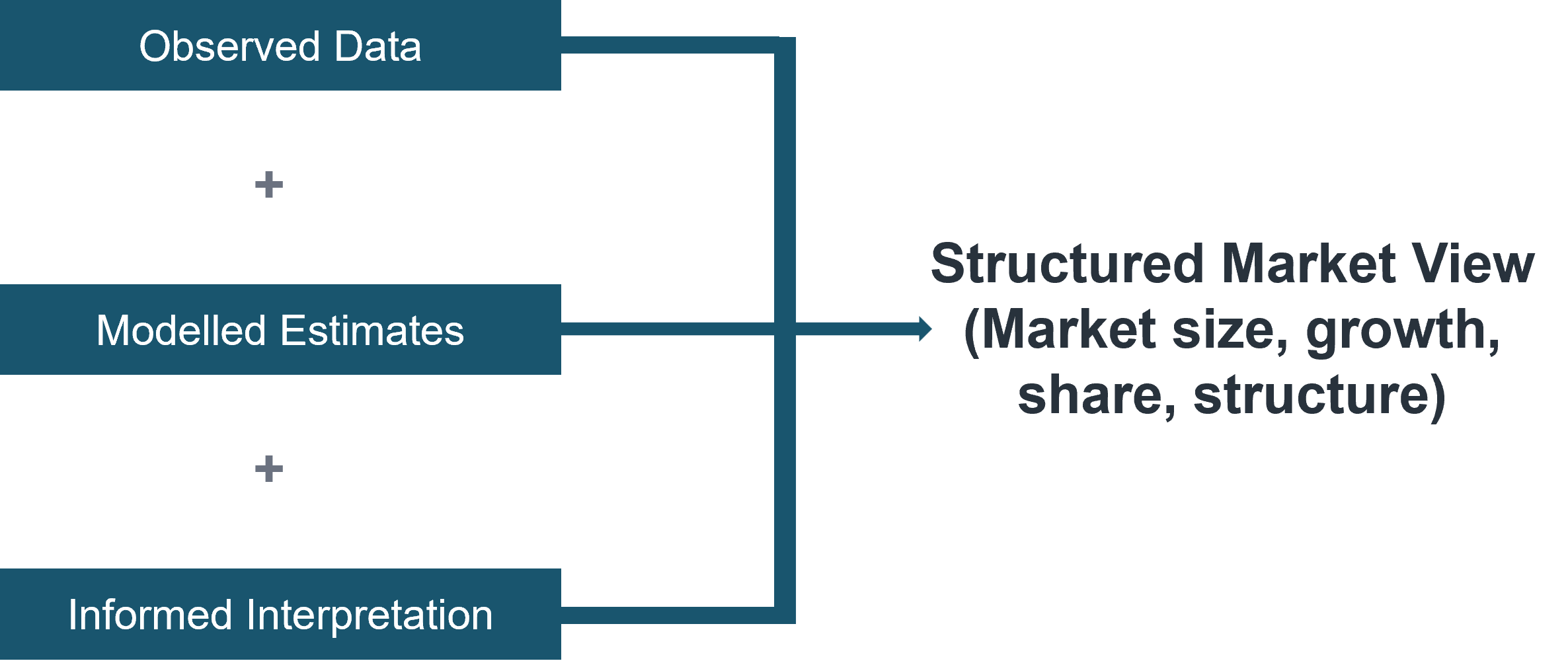
Demystify constructs market views through structured estimation — combining observed data, modelled estimates, and informed interpretation.
This ensures that Demystify’s outputs are:
Coherent — aligned to defined market structures
Comparable — consistent across segments and adjacencies
Decision-relevant — suitable for prioritisation and trade-offs
Vendors are positioned within workflows
This approach:
Enables clear positioning within market structure
Supports like-for-like comparison across providers
Identifies overlaps, adjacencies, and competitive dynamics
Vendors are analysed in the context of the roles they play within workflows and product categories — rather than as standalone entities.
Insight is structured to enable decisions
Analysis is designed to move from:
Signal — what is happening
Interpretation — what it means
Decision — what it enables
Signal
What is happening
Interpretation
This ensures that market intelligence is not limited to description — but directly supports prioritisation, trade-offs and commitment.
What it means
Decision
What it enables